+86 18033331305


Choosing the right Pickleball Net Set Up supplier is not only about finding the lowest factory price. It is about consistency, portability, safety, and honest specifications. China has become a major sourcing base for pickleball equipment. Its suppliers offer compact frames, weather-resistant netting, reinforced edges, and custom packaging. However, quality can vary sharply between factories. A polished product photo proves very little. Buyers should inspect frame joints, pole thickness, center-strap design, stitching, and carry-bag durability. The net should measure 36 inches at the sidelines and 34 inches at the center. Small errors can change the playing experience. Sometimes, the difference is visible only after repeated assembly.
Pickleball coach and equipment educator Mark Renneson has said, “Good equipment should support better play, not distract from it.” That principle guides this review of China Top 10 Pickleball Net Set Up Suppliers. The selection considers manufacturing experience, product testing, material quality, customization, delivery reliability, and after-sales communication. It also examines how each supplier handles real court conditions, including uneven outdoor surfaces, wind, repeated folding, and school or community use. No supplier is perfect. Some may offer attractive pricing but weaker documentation. Others may provide stronger quality control while requiring larger orders. That trade-off deserves attention. A dependable supplier should explain its limits clearly, not hide them behind broad marketing claims. This guide aims to give buyers a practical starting point, while encouraging sample testing before serious procurement.
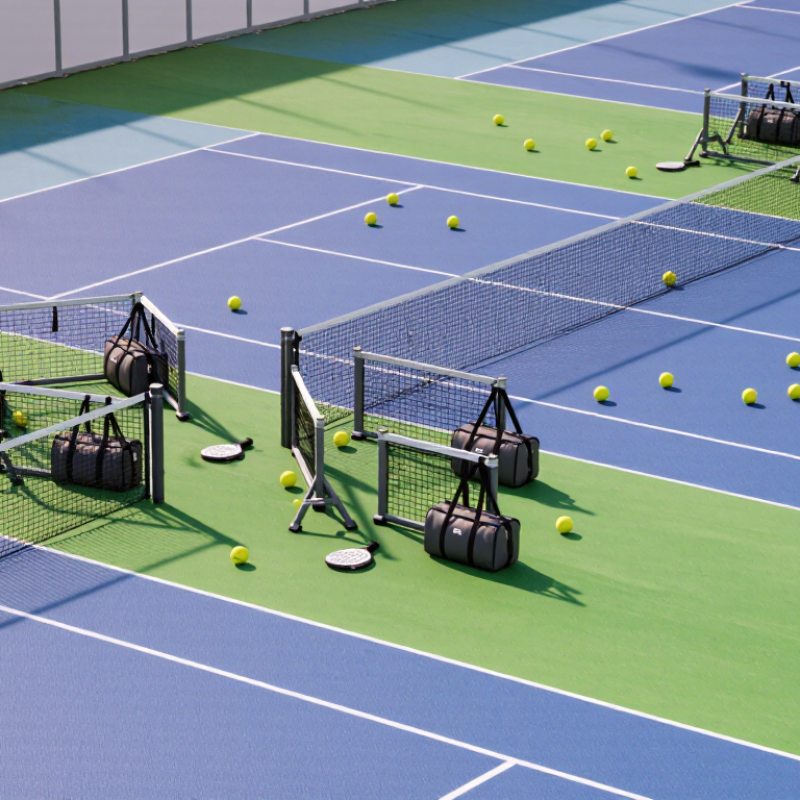
A pickleball net set usually includes the net, support posts, a frame or base, and a center strap. Some kits also provide ground stakes and a carry bag. Each part affects setup and stability. Mesh should feel evenly woven, with reinforced edges that resist sagging. Check the frame joints and feet, too. Loose connections can make a net wobble on a smooth court.
Tips: Assemble the frame on level ground. Tighten each connection by hand, then attach the net. Measure 36 inches at the sidelines and 34 inches at the center. Small adjustments matter.
Portable sets suit changing play locations, while heavier frames may stay steadier outdoors. Consider the surface, storage space, and how often the set will move. A carry bag helps, but it does not make every frame easy to transport. Inspect stitching, straps, and connectors before regular use. Instructions can be unclear, even in otherwise complete kits, so check the parts list before assembly. A missing pin is a small problem until game time.
China Top 10 Pickleball Net Set Up Suppliers
China’s pickleball net supply market is organized around different production roles, not simply ten interchangeable factories. Some manufacturers make frames and telescoping poles; others specialize in mesh, stitching, carry bags, or complete sets. Suppliers commonly coordinate these parts for export orders. Zhejiang, Guangdong, and Jiangsu have broad sporting-goods manufacturing networks, though capabilities vary by factory. Buyers should check who makes each component, who performs final assembly, and where inspection happens. The chain can be efficient. It can also be fragmented.
Demand helps explain the market’s momentum. SFIA’s 2024 Topline Participation Report estimated 13.6 million U.S. pickleball players in 2023, up 51.8% from 2022. That figure measures participation, not Chinese net orders, so it should not be treated as a direct sales forecast. Product checks matter more: USA Pickleball specifies a 22-foot net, 36 inches high at the sidelines and 34 inches at the center. Ask suppliers to verify those dimensions after setup, not only on a drawing. Inspect frame joints, seam strength, tension, and packed weight. Details show quality. Price alone does not. Public data rarely reveals factory-level capacity, and that makes supplier comparisons imperfect. A sample may look solid, yet repeated assembly can expose weak connectors.
Supplier evaluation should begin with court accuracy, not attractive pricing. The USA Pickleball Official Rulebook specifies a 22-foot net, with a 36-inch height at the sidelines and 34 inches at the center. Ask suppliers for measurement records, frame drawings, and tension-control procedures. A net that sags after one weekend may pass a factory inspection, yet fail during regular club use.
Demand is expanding quickly. The SFIA 2024 Topline Participation Report recorded 13.6 million pickleball players in the United States during 2023. It also reported 51.8% growth over the previous three years. This scale makes consistency important. Evaluate steel or aluminum tubing, coating thickness, mesh strength, wheel stability, and replacement-part availability. Request corrosion tests, load tests, and photographs from finished production batches. Factory audits are useful, but one visit cannot prove long-term quality.
Packaging deserves close attention. Check carton compression, foam protection, assembly instructions, and spare connectors. Confirm production lead times and inspect random units before shipment. Ask whether quality records are traceable by batch number.
I would not select a supplier from a sample alone. My own mistake was trusting a smooth setup demonstration without checking repeated assembly. The net looked precise, but the locking pins loosened later. Cost matters, though measurable performance matters more. Supplier claims should remain unverified until documents and physical testing agree.
China Top 10 Pickleball Net Set Up Suppliers
Profiles of Ten Leading Pickleball Net Set Suppliers in China
These ten Chinese suppliers show different strengths in portable pickleball net production. The selection considers materials, quality control, customization, and export experience.
Supplier One specializes in lightweight aluminum frames for clubs and training centers. Supplier Two produces steel frames with thicker powder coating for frequent outdoor use. Supplier Three offers quick-assembly systems with numbered poles and clear instruction sheets. Supplier Four focuses on compact packaging, helping reduce warehouse space and shipping costs.
Supplier Five develops reinforced mesh nets for schools and community courts. Supplier Six provides adjustable-height designs for coaching sessions and mixed-age players. Supplier Seven supports private-label packaging and customized color requests. Supplier Eight uses welded joints and protective corner caps to improve frame stability. Supplier Nine serves distributors seeking consistent replacement parts and repeat orders. Supplier Ten combines standard net sizes with flexible order quantities for smaller importers.
Practical evaluation still matters. Ask for samples, frame measurements, net tension tests, and packaging photos before placing an order. Factory audits can reveal storage problems that brochures never show. Confirm material certificates and inspection records when required by the destination market. Some suppliers communicate quickly but provide uneven technical details. That weakness deserves attention. A good supplier should explain assembly limits, corrosion risks, spare-part options, and realistic production schedules. No supplier is flawless. Careful comparison remains necessary.
Anonymous supplier-selection profiles. These are product and sourcing categories, not verified rankings or claims about specific companies. Confirm each supplier’s specifications, certifications, production capacity, and trade terms directly.
| Profile | Supplier Focus | Potential Product Fit | Key Details to Verify | Useful Performance Benchmark |
|---|---|---|---|---|
| 01 · Portable recreational sets | Complete, transportable net kits | Home use, parks, and casual play | Packed dimensions, assembled weight, included parts, and setup instructions | A regulation net is 22 ft long; verify the product’s stated use and dimensions. |
| 02 · Tournament-oriented systems | Full-size nets and sturdier support frames | Clubs and organized play | Net-height adjustment, frame stability, replacement parts, and applicable rule compliance | USA Pickleball’s standard net height is 36 in at the sidelines and 34 in at the center. |
| 03 · Metal-frame specialists | Portable sets using metal support components | Frequent assembly and repeated use | Metal grade, tube dimensions, coating, weld quality, and corrosion testing | Request material specifications and test reports; do not infer durability from appearance alone. |
| 04 · Lightweight-frame suppliers | Sets designed to reduce carrying weight | Travel, temporary courts, and recreational users | Total kit weight, frame rigidity, joint design, and wind-use limitations | Compare the complete packed kit, not just the frame’s advertised weight. |
| 05 · Replacement-net providers | Replacement nets and net components | Clubs maintaining existing equipment | Net length, height, sleeve and strap design, mesh material, and frame compatibility | Check that the net fits the customer’s existing frame and desired court setup. |
| 06 · Customization-capable suppliers | Custom colors, packaging, or product configurations | Importers and private-label buyers | Available options, artwork approval, tooling charges, minimum order, and lead time | Approve a production sample and written specification before confirming a bulk order. |
| 07 · Export-packaging focused suppliers | Retail-ready or shipment-conscious packaging | E-commerce and overseas distribution | Carton dimensions, gross weight, packaging tests, labeling, and pallet details | Request a carton specification to estimate freight and storage requirements accurately. |
| 08 · Accessory-bundle suppliers | Net sets supplied with carrying bags or court accessories | Gift, starter, and all-in-one product bundles | Exact bill of materials, accessory quality, bag dimensions, and package contents | Have every included item listed in the quotation and confirmed sample. |
| 09 · Multi-product sports-equipment suppliers | Pickleball nets alongside other sports products | Buyers consolidating multiple product categories | Which production steps are in-house, subcontracted, or independently inspected | Verify the actual manufacturing and quality-control arrangements for the net set. |
| 10 · Project-order suppliers | Bulk supply for facilities or institutional buyers | Schools, recreation centers, and multi-court projects | Order capacity, delivery schedule, spare-parts plan, inspection terms, and warranty scope | Confirm quantities, specifications, acceptance criteria, and delivery milestones in writing. |
Note: Net dimensions above reflect USA Pickleball guidance. Supplier-specific pricing, minimum order quantities, certifications, and factory details are not stated because they require direct verification and may vary by product and order.
Comparing China’s top ten pickleball net setup suppliers works best when buyers assess products, customization, and quality controls together. A portable set may include a steel frame, net, ground stakes, carry bag, and tension straps. Check tube thickness, net height and width, packed weight, and replacement-part availability. A clear assembly guide matters; loose fittings can turn setup into a frustrating courtside task. Small details matter.
Ask suppliers which options can be changed, such as frame color, net material, logo placement, or bag dimensions. Confirm minimum order quantities, sample costs, and production timelines in writing. For quality control, request inspection criteria for frame welds, stitching, net tension, and package contents. Photos of a sample are useful, but they do not replace a hands-on check. If possible, assemble one unit and test it on a hard surface and a windy court. Supplier descriptions can sound similar. Actual durability may differ, so compare the same specifications across quotes and record any gaps before ordering.
Tips: Request a sample and a parts list. Check that the net stays taut after repeated setup. Ask how defects are recorded and corrected, not just whether products are inspected.