Why Is Proper Pickleball Net Setup Important?
A proper Pickleball Net Set Up does more than make a court look ready. It creates a fair playing environment where every rally begins with consistent conditions. The net must stand at the correct height, remain centered, and stay firmly supported. Even a slight sag can change the ball’s path near the middle. A loose base may shift after one hard collision. Small errors matter.
Pickleball coach Mark Renneson captures this practical point well: “A good setup gives players a fair chance to show their skills.” That idea applies to beginners, recreational groups, and competitive athletes. When the net is stable, players can focus on placement, footwork, and decision-making. They are not adjusting to equipment that quietly works against them.
A careful setup also protects the court experience. Check the center strap before play. Measure the net at both sidelines and the center. Look for twisted mesh, uneven tension, or worn connection points. These details are easy to ignore. I have seen players correct the net only after several games, when frustration had already grown.
Proper setup cannot fix every problem. Wind, court slope, and imperfect equipment still affect play. However, it removes avoidable uncertainty. This guide explains why net accuracy matters and how simple checks can improve safety, consistency, and enjoyment. The process is not complicated. It just rewards attention.
Why Pickleball Net Setup Matters for Fair and Safe Play
Why Is Proper Pickleball Net Setup Important?
Why Pickleball Net Setup Matters for Fair and Safe Play
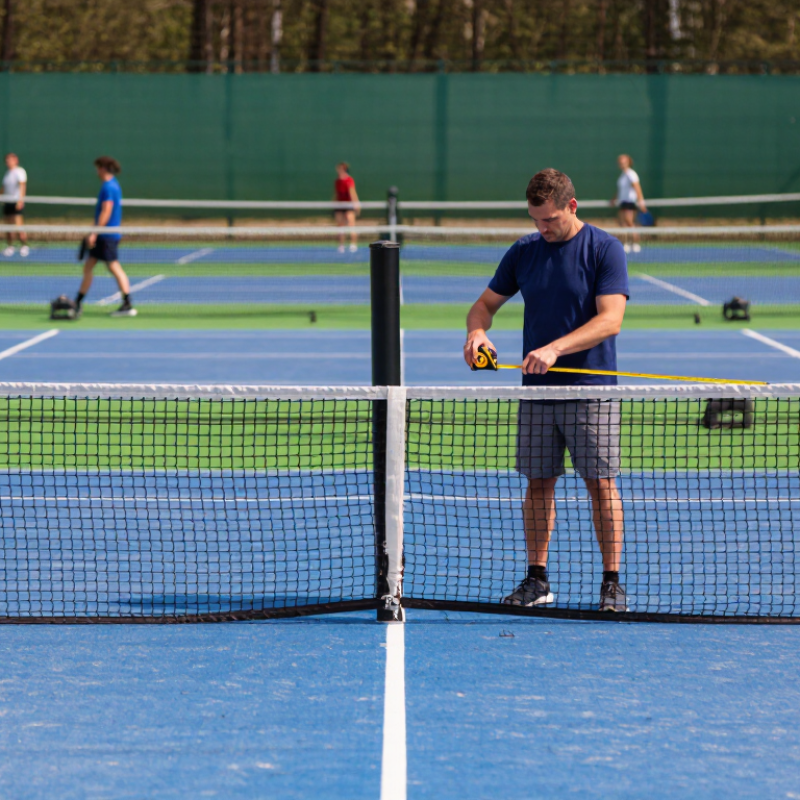
A net that sags in the middle can turn a close rally into an argument. The 2024 Official Pickleball Rulebook specifies a height of 36 inches at the sidelines and 34 inches at the center. Those two inches matter: they create a consistent target across the court and help players judge low shots fairly. Before play, measure both points with a tape measure. Check that the posts are stable and the net is taut, not pulled so tight that it rises above the required height. Small setup errors are easy to miss.
Consistency matters as the sport grows. The 2024 SFIA Topline Participation Report estimated that 13.6 million Americans played pickleball in 2023, making clear how many players rely on shared standards. A level net also reduces awkward collisions with loose straps or leaning posts, especially when players chase a short ball. Walk the full net line before starting. Look for frayed cords, loose ground anchors, and gaps near the posts. I have seen players skip this check when eager to begin; it seems harmless until a ball catches the net edge and the point becomes disputed. Reliable setup cannot prevent every disagreement, but it gives both sides the same conditions.
Why Is Proper Pickleball Net Setup Important? — Why Pickleball Net Setup Matters for Fair and Safe Play
| Setup dimension |
Standard or check |
Why it matters for fair play |
Why it matters for safety |
| Net height at the sidelines |
36 in (91.4 cm) |
A consistent height helps make shots and serves comparable across the court. |
A properly tensioned net is less likely to sag or shift during play. |
| Net height at the center |
34 in (86.4 cm) |
The lower center height is part of the standard net profile and affects how the ball travels over the middle. |
Checking the center helps identify uneven tension or an incorrectly installed net. |
| Court dimensions |
20 ft wide × 44 ft long (6.10 × 13.41 m) |
Accurate boundaries give both sides equal playing space and make line calls more reliable. |
Correct spacing helps keep play within a defined area and away from nearby obstacles. |
| Non-volley zone depth |
7 ft (2.13 m) from the net on each side |
Clearly marked lines help players apply the same volley rules on both sides. |
Visible markings make boundaries easier to recognize during fast movement. |
| Net position and alignment |
Center the net across the court; keep it straight and secure |
A centered net prevents one side from having a different effective court width or playing angle. |
Secure supports reduce the risk of the net or posts tipping into the playing area. |
| Playing surface and surrounding area |
Use a level, non-slip surface and keep the court clear of loose objects |
A clear, even court supports consistent movement and reduces interruptions. |
Removing debris and checking for slippery or uneven spots helps reduce trips and falls. |
Measurements shown are standard pickleball court and net dimensions. Check the applicable rulebook when setting up a court for organized play.
How to Check Net Height, Alignment, and Stability
Why Is Proper Pickleball Net Setup Important?
How to Check Net Height, Alignment, and Stability
A properly set net keeps rallies fair and helps players judge shots accurately. During setup, measure 36 inches at both sidelines and 34 inches at the center. Use a reliable tape measure, not your eye. I once assumed a net looked level, but the center was several inches too low. That small mistake changed the ball’s bounce and made soft shots unpredictable.
Check that the net runs straight across the court and remains parallel with the baselines. The court should measure 20 feet wide, while the net spans the full playing area between the posts. Confirm that the center strap sits directly over the court’s centerline. Walk around the net and inspect every connection. Posts should stand upright, and the net should feel firm without excessive sag. A loose post can shift during play. That creates a safety concern.
Tips: Place a level along the top edge before play. Pull the center strap gently, then recheck the side heights. Test stability by pressing the posts lightly. They should not wobble. Inspect the bottom edge for gaps that could catch a ball. If the surface is uneven, adjust the setup and measure again. I sometimes skip this final check when players are waiting, but that habit is worth reconsidering. Two quiet minutes can prevent hours of inconsistent play.
Why Is Proper Pickleball Net Setup Important?
How to check net height, alignment, and stability
Regulation pickleball nets are 34 inches high at the center and 36 inches high at the sidelines.
The net should span the full 20-foot court width, remain centered between the sidelines, and be firmly secured.
Before play, check that the center strap is adjusted correctly, the net is taut, and the posts do not shift when lightly pushed.
Common Setup Errors and Their Effects on Gameplay
Why Is Proper Pickleball Net Setup Important?
Common Setup Errors and Their Effects on Gameplay
A net that sits too high can turn soft shots into frustrating rebounds, while a low center may make serves and drives easier than intended. A regulation net is 36 inches high at the sidelines and 34 inches at the center. Check both points with a measuring tape rather than judging by eye. Close enough can still be off.
Uneven tension is another common mistake. If one side sags, the ball may dip unpredictably or catch the net during a rally. Posts placed too far inside the sidelines can also narrow the playing area and create awkward angles near the edges. I have seen players blame a poor bounce on their timing, only to notice the net leaning slightly. It is easy to miss.
Before play, center the net across the court, secure the posts, and check its height at both ends and the middle. Watch a few balls travel over it from different parts of the court. If the net moves or the ball clips it unexpectedly, pause and adjust. A quick check takes little time, though people do sometimes rush it.

 +86 18033331305
 CONTACT NUMBER
 CONTACT NUMBER