 +86 18033331305
Leave Your Message
-
CONTACT NUMBER
-
 CONTACT NUMBER
-
 CONTACT NUMBER
Choosing the China Best Beginner Pickleball Paddle for Global Buyers requires more than comparing colorful designs and low prices. A suitable paddle should feel stable, comfortable, and easy to control during early practice. It should also meet the buyer’s market requirements and quality expectations.
This guide examines what makes a Good Beginner Pickleball Paddle for new players. We will consider weight, grip size, surface texture, core construction, edge protection, and balance. These details matter on a real court. A paddle that feels light in a product photo may feel tiring after thirty minutes of play. A thick grip may also reduce wrist comfort for smaller hands.
China has a broad pickleball manufacturing base, including factories with export experience and product testing systems. However, supplier quality can vary. Buyers should request clear specifications, sample paddles, material information, packaging details, and inspection records. A confident supplier should explain these points without avoiding difficult questions. That is practical evidence of reliability.
There is no single paddle that suits every beginner. Some players prefer a softer touch, while others need stronger impact feedback. Personal testing remains important. Even experienced buyers can misjudge balance from catalog data alone. A sample may reveal small issues, such as an uneven handle or noisy edge guard. These imperfections deserve attention, not excuses.
The following outline offers a careful framework for product selection, supplier evaluation, customization, and international purchasing decisions. It aims to help global buyers choose with evidence rather than attractive promises.
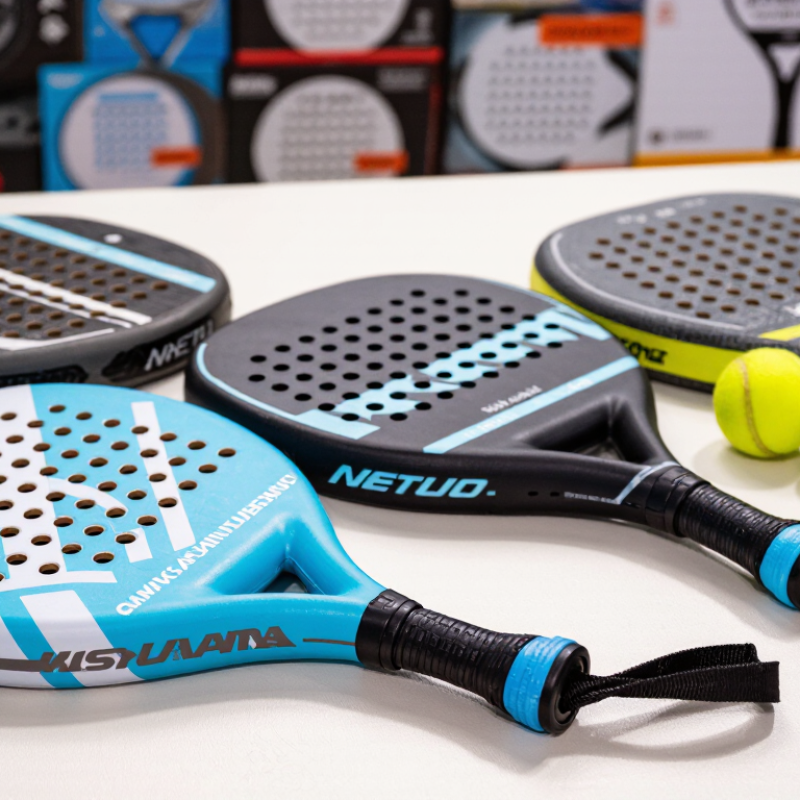
For global buyers, a beginner-friendly pickleball paddle should feel predictable, not extreme. The SFIA 2024 Topline Participation Report recorded 13.6 million U.S. pickleball players in 2023. That growth attracts first-time players worldwide, but equipment choices remain confusing. A lighter paddle, usually around 7.3 to 8.3 ounces, can reduce wrist fatigue. However, very light models may feel unstable during off-center hits. A medium weight often offers a better learning balance.
Control matters more than aggressive power at the beginning. A textured composite surface can help produce consistent contact, while a wider face may increase the sweet spot. USA Pickleball’s Equipment Standards Manual provides official limits for paddle dimensions and performance. Global buyers should also check handle length, circumference, and local import measurements. A grip that feels too large can slow reaction speed. I have found that beginners often choose by appearance first. That is not always sensible.
Tips: Hold the paddle for five minutes before buying. Try gentle forehand and backhand swings. Check the total weight, grip size, edge protection, and return policy. For outdoor play, confirm weather-resistant materials and quieter performance. Noise expectations differ between communities, so the “best” beginner paddle is not universal. A low-cost option may teach well, but it can also wear faster. That trade-off deserves honest attention.
A practical specification guide for evaluating beginner-friendly pickleball paddles manufactured in China and supplied to international markets.
| Evaluation Dimension | Beginner-Friendly Target | Common Practical Range | Why It Matters for New Players | What Global Buyers Should Verify |
|---|---|---|---|---|
| Overall Length | 15.5–16.0 in (39.4–40.6 cm) |
15.0–17.0 in (38.1–43.2 cm) |
Provides a useful balance between reach, maneuverability, and control. Extremely long paddles can feel less stable for beginners. | Confirm the finished length, including any edge guard, and ensure it does not exceed the applicable competition limit of 17 in (43.2 cm). |
| Overall Width | 7.5–8.0 in (19.1–20.3 cm) |
7.0–8.0 in (17.8–20.3 cm) |
A wider face gives beginners a larger effective hitting area and makes off-center contact more forgiving. | Check the finished width and the combined length-plus-width measurement. Standard competition specifications limit the combined total to 24 in (61.0 cm). |
| Weight | 7.5–8.3 oz (213–235 g) |
Light: under 7.3 oz Midweight: 7.3–8.4 oz Heavy: over 8.4 oz |
Midweight paddles generally offer a manageable swing while retaining enough mass for stable contact and consistent shots. | Request an actual production-weight tolerance, such as ±0.2 oz or ±6 g, rather than relying only on a nominal specification. |
| Core Material | Polymer honeycomb core | Commonly polypropylene or similar polymer honeycomb construction | Polymer cores are widely used because they can provide a softer feel, lower vibration, and predictable control for recreational play. | Ask for the core polymer type, cell size, bonding method, and batch consistency. Do not assume the core is polypropylene unless it is documented. |
| Core Thickness | 14–16 mm (approximately 0.55–0.63 in) |
Typically 10–20 mm (approximately 0.39–0.79 in) |
A thicker core usually prioritizes touch, stability, and vibration reduction, which are useful qualities for players still developing technique. | Verify actual thickness at multiple points and ask whether the listed thickness includes the face layers or refers only to the core. |
| Face Material | Fiberglass or balanced carbon-fiber construction | Fiberglass, carbon fiber, or hybrid composite faces | Fiberglass can offer a comfortable, responsive feel, while carbon-based faces may provide a more controlled and consistent response. | Confirm the face material, weave type, layer count, resin system, and whether the stated material covers the entire playing surface. |
| Playing Surface | Moderate texture with a smooth, even finish | Smooth to lightly textured surfaces | A moderate texture can help with basic spin development without making the paddle feel overly demanding or inconsistent. | Request surface-uniformity checks and applicable tournament-conformity documentation. Avoid unsupported claims about spin performance. |
| Handle Length | 4.75–5.25 in (12.1–13.3 cm) |
Approximately 4.0–6.0 in (10.2–15.2 cm) |
A medium handle suits most new players and leaves enough room for a comfortable single-handed grip without making the paddle head difficult to control. | Measure from the butt cap to the throat and specify whether the measurement includes the cap. Offer longer handles only when two-handed backhands are a priority. |
| Grip Circumference | 4.125–4.375 in (10.5–11.1 cm) |
Approximately 4.0–4.75 in (10.2–12.1 cm) |
A medium grip is a practical starting point for many adult beginners and can reduce excessive hand tension during play. | Define the measurement method and account for the replacement grip or overgrip. Offer more than one size for different international hand profiles. |
| Grip Surface | Perforated, moisture-absorbing synthetic grip | PU, microfiber, or synthetic leather-style grips | A cushioned, moisture-managing grip improves comfort and helps beginners maintain a relaxed, secure hold. | Check sweat absorption, seam quality, odor, adhesion, replacement availability, and performance after humidity or heat exposure. |
| Handle Comfort | Rounded or slightly tapered handle with cushioned butt cap | Rounded, rectangular, or flared handle profiles | A comfortable profile helps reduce pressure points and makes it easier for new players to learn a consistent grip. | Request drawings with handle dimensions, butt-cap diameter, bevel details, and tolerance limits for mass production. |
| Edge Protection | Low-profile, securely bonded edge guard | Integrated, separate, or edgeless construction | Edge protection helps reduce damage from court contact while a low profile limits unnecessary weight around the paddle perimeter. | Inspect bonding strength, corner coverage, replacement options, and whether the edge guard changes the declared length or width. |
| Balance Point | Neutral to slightly head-light balance | Head-light, even-balance, or head-heavy designs | A neutral or slightly head-light paddle is usually easier to maneuver at the kitchen line and less tiring for first-time players. | Request the balance point measured from the butt end, using a consistent method and a stated production tolerance. |
| Vibration Management | Stable layup with a cushioned grip or internal damping element | Grip cushioning, throat inserts, foam edge systems, or multilayer construction | Reduced vibration can improve comfort and make the paddle feel less harsh when contact is not perfectly centered. | Use standardized sample testing and player feedback; avoid presenting vibration claims as medical or injury-prevention guarantees. |
| Quality Consistency | Documented inspection plan with measurable tolerances | Weight, dimensions, cosmetic finish, bonding, and flatness checks | Consistent production is more important than an impressive single sample when purchasing for multiple markets. | Request pre-production samples, approved reference samples, inspection records, defect classifications, and corrective-action procedures. |
| Packaging for Global Shipping | Protective sleeve, edge protection, moisture-resistant carton, and recyclable materials where practical | Single-unit cartons or multi-unit export cartons | Good packaging helps prevent face scratches, crushed corners, moisture exposure, and transit-related returns. | Check carton dimensions, drop-test requirements, pallet configuration, barcode placement, country labeling, and documentation for the destination market. |
| Recommended Beginner Positioning | Control-focused, all-court recreational paddle | Control, balanced, power-oriented, or specialty designs | Control-focused positioning is easier for beginners to understand and supports learning reliable placement before advanced power or spin techniques. | Match product claims to measurable specifications and avoid using “best” as an absolute claim without test criteria and market context. |